Start
End
Guest Lecture Report
on “Trends in Advanced VLSI Design – Career Opportunities”
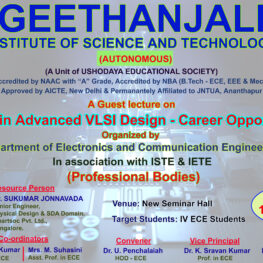
The Electronics and Communication Engineering department in association with ISTE and IETE professional bodies of Geethanjali Institute of Science and Technology, Gangavaram, Nellore organized a guest lecture on 17-10-2025. The resource person is Mr. Sukumar Jonnavada, Senior Engineer, Physical Design & SDA Domain, Smartsoc Pvt. Ltd., Bangalore. He delivered lecture on “trends in Advanced VLSI Design – Career Opportunities” for IV ECE students in the new seminar hall. A total of 126 students and faculty members of ECE department participated in the event.
Dr. U. Penchalaiah introduced the resource person and enlightened final-year students about the emerging technologies and professional opportunities in the rapidly growing field of Very Large Scale Integration (VLSI) design.
After the introduction of the resource person, HOD along with all the department staff felicitated the resource person.
Felicitating the Resource Person
The main goal of the session was to provide students with a comprehensive understanding of:
- The latest technological trends and innovationsin VLSI design.
- The importance of VLSIin modern electronics and embedded systems.
- Career opportunitiesand required skill sets in the semiconductor and chip design sectors.
- The significance of EDA tools, design verification, and fabrication techniquesused in the industry.
The lecture began with an introduction to VLSI technology, explaining how millions of transistors are integrated onto a single silicon chip to build powerful and efficient electronic devices. The resource person elaborated on the evolution of VLSI, from SSI and MSI circuits to ULSI and SoC (System on Chip) technologies that are integral to today’s smartphones, computers, and AI hardware.
The speaker highlighted the growing career opportunities in the semiconductor industry, both in India and abroad, emphasizing the need for students to develop strong foundations in digital electronics, CMOS design, and HDL programming. He also discussed emerging roles such as VLSI design engineers, physical design engineers, and verification engineers, offering practical insights into industry expectations and required skill sets.
Explaining about integrated circuit (IC)
He discussed the major design domains in VLSI—front-end design, back-end design, and testing—highlighting the importance of each stage in the chip development process. The students gained exposure to various EDA tools such as Cadence, Synopsys, and Mentor Graphics, which are extensively used in the industry for design and simulation.
He also elaborated on the VLSI design flow, including:
- Specification and System Design
- RTL Design (Register Transfer Level) using HDL languages like Verilog and VHDL
- Functional Simulation and Synthesis
- Physical Design (Placement, Routing, and Timing Analysis)
- Fabrication and Testing of Integrated Circuits.
He presented the current trends in the VLSI industry, focusing on cutting-edge technologies such as:
- FinFET (Fin Field Effect Transistor)and GAAFET (Gate-All-Around FET) architectures for nanoscale chips.
- System-on-Chip (SoC)and Application-Specific Integrated Circuits (ASIC) design methodologies.
- Low Power VLSI Designfor energy-efficient devices.
- 3D IC design and advanced packaging technologiesfor high performance and compact devices.
- AI/ML-assisted Chip Designand EDA automation tools for faster time-to-market.
He emphasized the need for engineers to develop strong fundamentals in Digital Logic Design, CMOS Technology, Semiconductor Physics, and HDL programming to adapt to the changing design environments.
The session concluded with an interactive Question & Answer segment, where students enthusiastically asked questions regarding career paths, required certifications, required technical skills, and the scope of VLSI in India compared to abroad.
Students asking queries
The resource person patiently answered all queries, sharing valuable advice and motivating students to pursue careers in this dynamic and rapidly growing sector.
The session significantly enhanced students’ awareness of VLSI design principles and industry practices. It motivated them to pursue higher studies and research in microelectronics, semiconductor technology, and embedded systems.